Taliesin’s Bardic Cosmology
Astronomical and Structural Analysis of Preiddeu Annwfn
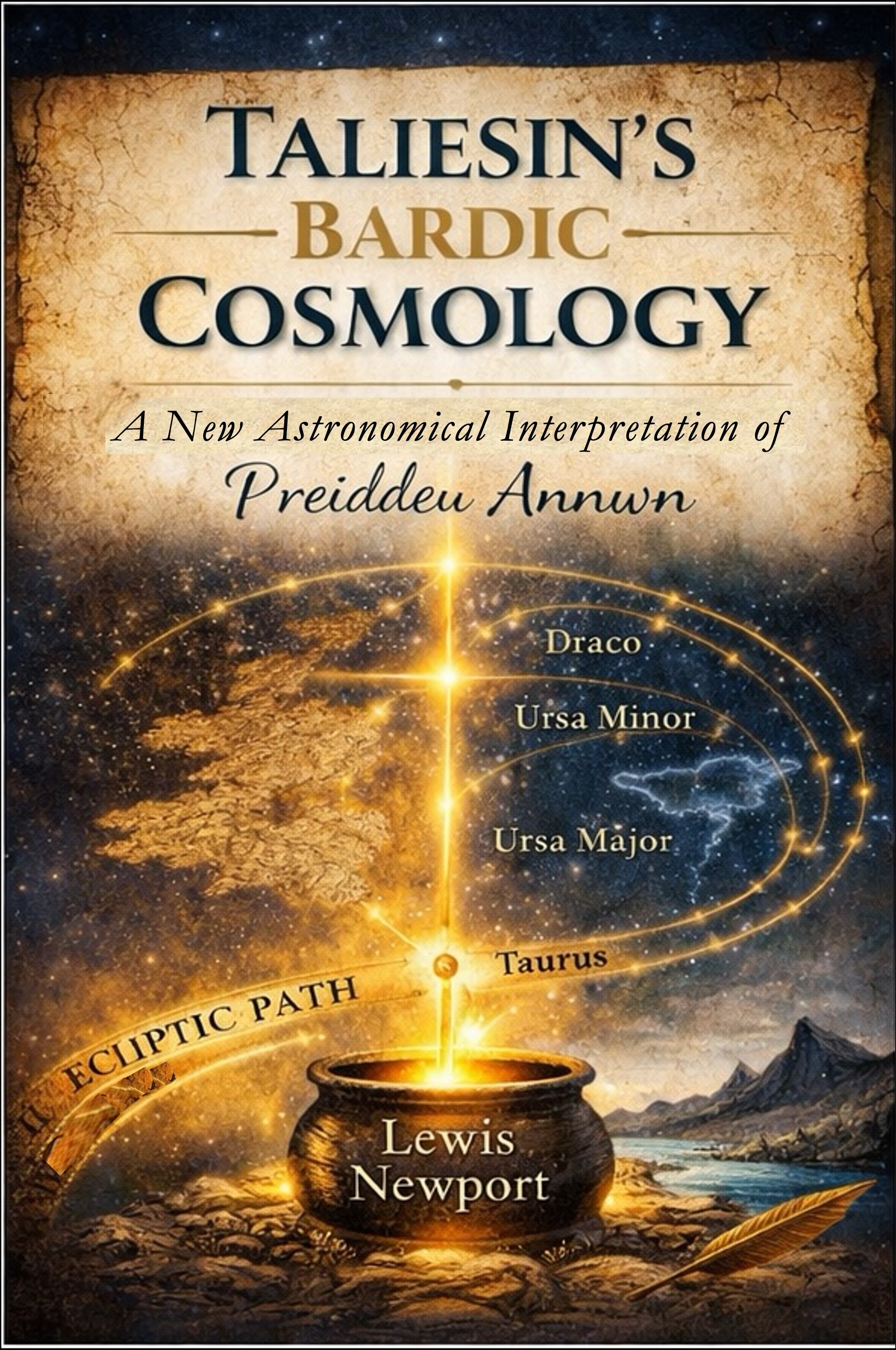
Taliesin’s Bardic Cosmology is a study of one of the most difficult and powerful poems in the Welsh tradition: Preiddeu Annwfn, often translated as The Spoils of Annwfn.
The poem has frequently been read as a mythic raid into the Otherworld. This study proposes a different approach.
It examines the poem as a sophisticated cosmological composition, structured through astronomical imagery, poetic concealment, symbolic fortresses, circular motion, and the language of Bardic knowledge.
Re-reading Preiddeu Annwfn
Preiddeu Annwfn is not a simple narrative.
Its language is compressed, allusive, and deliberately difficult. It speaks of mysterious fortresses, a cauldron, a company that journeys and returns, watchers, enclosures, luminous structures, and repeated refrains.
Rather than treating these images as disconnected mythic symbols, Taliesin’s Bardic Cosmology reads them as parts of a structured design.
The poem is approached as a map of movement through a cosmological order.
The Bard as Master of Concealed Meaning
Taliesin was not merely a poet in the modern sense. He was a master of layered meaning.
His poetry can operate on several levels at once: literal, symbolic, professional, cosmological, and initiatory. Its difficulty is not weakness, but method.
This study treats Taliesin as a poet of exceptional technical skill, capable of using ambiguity, sound, number, repetition, and image to preserve meanings that were never intended to be obvious to the untrained reader.
The Fortresses of the Poem
The repeated references to caerau — fortresses or enclosed places — are central to the study.
Rather than interpreting them only as legendary locations, this work explores their possible astronomical and cosmological significance.
The fortresses are examined in relation to:
The ecliptic path
The firmament
The polar region
Circumpolar constellations
The turning of the heavens
The symbolic boundary between known and unknown worlds
This approach allows the poem to be read as a sequence of ordered stations rather than a confused catalogue of otherworldly places.
The Cauldron and Annwfn
The cauldron in Preiddeu Annwfn is one of the most famous images in Welsh literature.
In this study, the cauldron is not reduced to a simple magical object. It is considered as a symbolic centre, associated with Annwfn, depth, hidden origin, transformation, and the unseen source from which inspiration and renewal emerge.
The result is a reading in which the cauldron belongs to a wider cosmological structure, rather than to a single tale of possession or theft.
Astronomy and Poetic Structure
The study uses astronomical reasoning carefully and structurally.
It does not claim that every image in the poem is a star or constellation. Instead, it asks whether the poem’s repeated patterns of enclosure, turning, journeying, watching, rising, circling, and returning correspond to a traditional way of imagining the heavens.
This includes consideration of:
The ecliptic
The polar axis
Circumpolar stars
The Milky Way
Seasonal and celestial motion
Ancient observational astronomy
The symbolic geography of sky and deep
Diagrams and Visual Analysis
A major feature of the work is its diagrammatic approach.
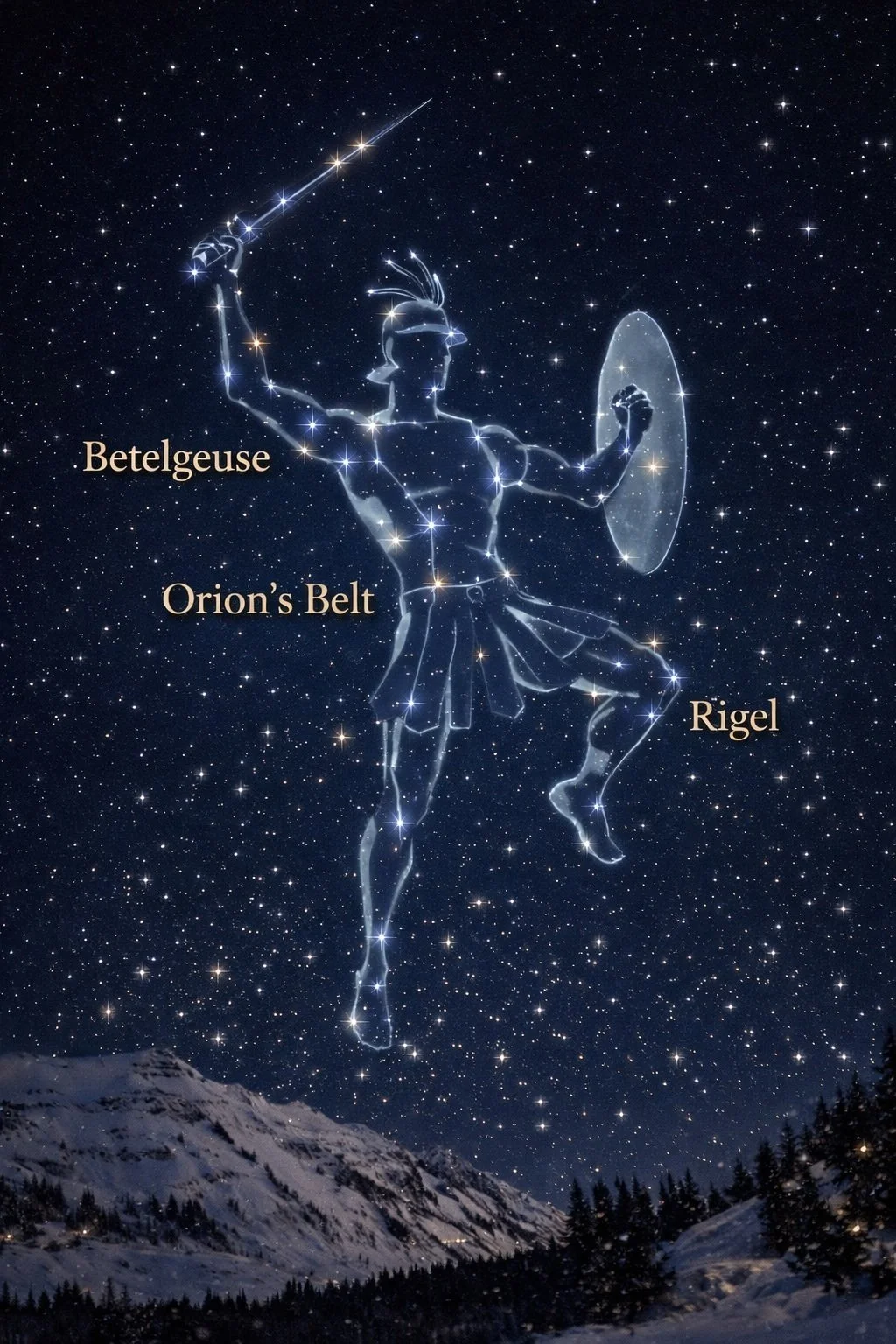
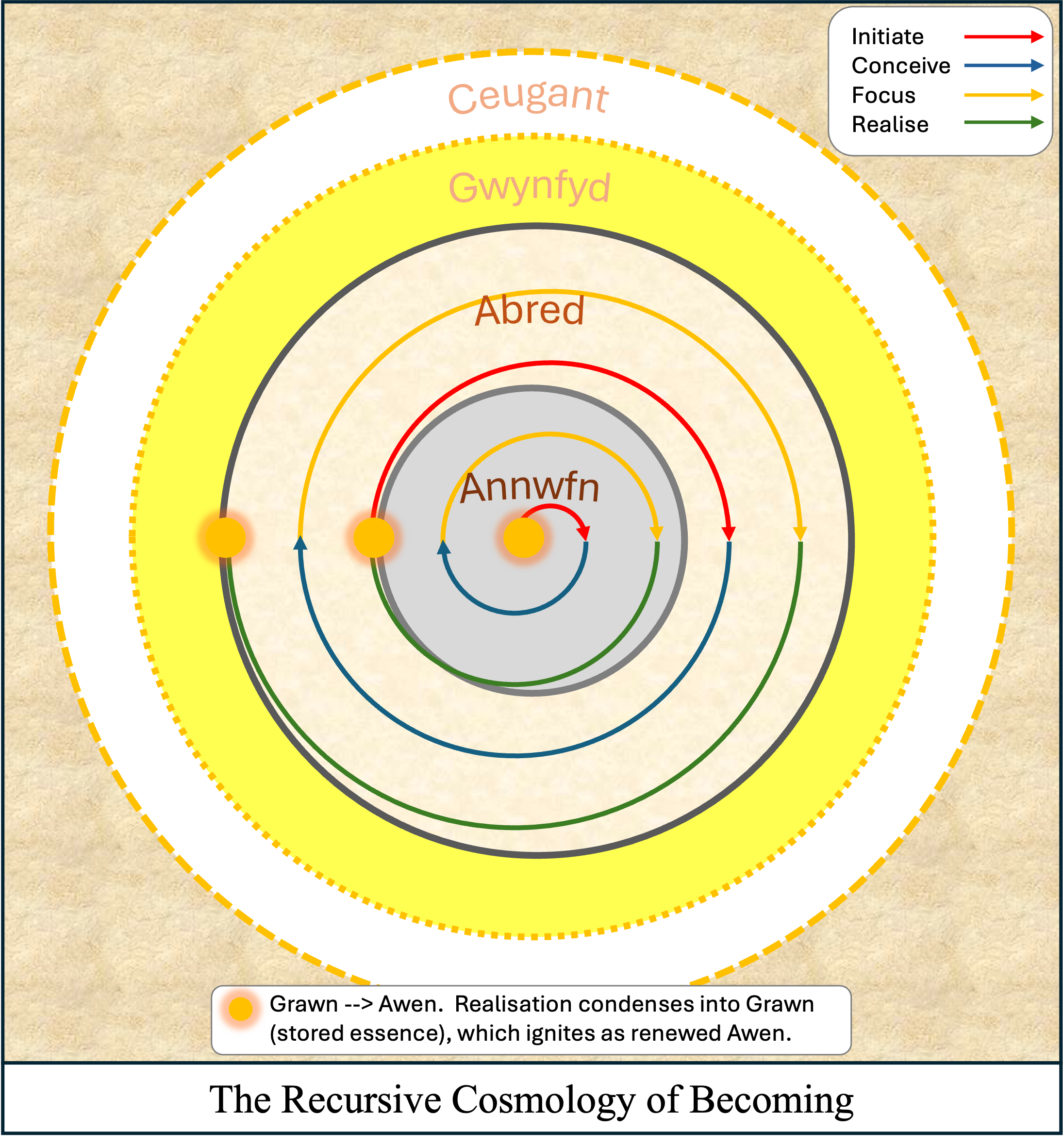
Cosmological diagrams, sky maps, circular models, and structural illustrations are used to help readers see how the poem may be organized.
These visuals are not decorative. They are interpretive tools, designed to show relationships between poetic language, astronomical motion, and traditional cosmological structure.
Who This Book Is For
This work is intended for readers who want to go deeper into Taliesin, Welsh poetry, and ancient cosmology.
It will be of interest to:
Readers of Taliesin
Students of Welsh myth and poetry
Researchers of Bardic tradition
Readers interested in ancient astronomy
Students of Druidic and Ovatic cosmology
Anyone interested in the hidden architecture of traditional poetry
Taliesin’s Bardic Cosmology invites readers to see Preiddeu Annwfn not as a broken relic or obscure fantasy, but as a brilliant composition by a master poet.
Its difficulty is part of its design. Its obscurity protects its depth. Its images may preserve one of the most remarkable cosmological visions in the Welsh tradition.